Friday, 27 October 2017

US publishes thousands of files on Kennedy, withholds others

US President Donald Trump has decided to keep some files on the assassination of John F. Kennedy secret, following appeals from the FBI and the CIA. The remaining trove of nearly 2,900 records has been published.
John F. Kennedy portrait (REUTERS)
The US National Archives released the secret documents on Thursday, just hours before the legal deadline for their publication was set to expire. The long-awaited release is expected to shine additional light onto the fatal Dallas shooting in 1963, which investigators attributed to Lee Harvey Oswald. The former Marine was himself shot and killed before the trial.
Even today, however, many Americans believe that part of the story is being kept away from the public eye. Some conspiracy theories link the Kennedy assassination with the US intelligence apparatus, the military, or the Italian mafia.
Among the documents released on Thursday, there was a transcript of a November 24, 1963, conversation with J. Edgar Hoover, who was FBI director at the time.
Kennedy's motorcade in Dallas (Reuters/Walt Cisco/Dallas Morning News)
John F. Kennedy and his wife moments before Kennedy was shot
The FBI informed police of a threat against the life of Oswald the night before he was killed. However, the police did not act on the tip, Hoover said.
US President Donald Trump approved the release of a 2,891-document trove, but decided that hundreds of additional documents will remain secret. According to White House officials cited by news agencies, Trump made this decision after the FBI and the CIA urged him to do so.

Little Caesars, business opportunity

Dear Mr. NK,
Greetings!
Trust you are well. We are trying to get in touch with you regarding business opportunity with US based famous Pizza brand by the name of Little Caesars (one of the World’s largest pizza chain Behind Domino’s). They are planning to enter Indian market and looking for a PAN India or Regional partner.
Headquartered in Detroit, Michigan, Little Caesars is the largest carryout-only pizza chain in the world and the fastest growing pizza chain in America. Founded in 1959 as a single, family-owned restaurant, Little Caesars operates in all 50 U.S. states, as well as 25+ countries and territories worldwide with 5500+ Outlets. Known for its HOT-N-READY® pizza and famed Crazy Bread®.
Voted Best Value in America 10 years in a row “Highest Rated Chain – Value for the Money” based on a nationwide survey of national quick-service restaurant customers.
We would like to inform you that Mr. Bill Schreiber, (Vice President Worldwide Development of Little Caesars Pizza) is travelling to New Delhi on Tuesday, 7th and Wednesday, 8thNovember to participate in Asia’s largest Franchising & Retail event at Pragati Maidan, Delhi over there 200+ leading International Brands are participating and looking for a partner (Master Franchise and Joint Venture) in India. We would like to organise your meeting with him directly.
Look forward to hearing from you.
Thanks,
Best Regards,
Naseem Choudhary

Dr Subramaniam Swamy, MP to release book on Black Money And Tax Havens

Open this email on your web browser | Forward this email to a friend
Black Money & Tax Havens

Dr Subramanian Swamy
to release a book by
Prof R Vaidyanathan
Just how much black money is there in India? Estimates vary from 10% to 20% of our GDP. Conservatively, Rs15 lakh crore (10% of Rs150 lakh crore, our GDP in 2016-17). 
As for Indian money in tax havens around the world?
Around Rs65 lakh crore. Truly astounding figures! Come and Listen to Dr Swamy and Prof Vaidyanathan, two of the distinguished authorities on black money.
For Online Registration click here
Date: Friday, 27 October 2017 Time: 6pm to 8pm
Venue: BSE International Convention Hall, 1st Floor, P. J. Towers, Dalal Street, Fort, Mumbai – 1
RSVP : Shilpa at 022-49205000 or email foundation@moneylife.in or Call/SMS/ WhatsApp on +91-7045156415 (Please give your Name. email ID & Contact number)

India will face Kazakhstan in the semifinals at the FIBA U16

India will face Kazakhstan in the semifinals at the FIBA U16 Women’s Asia Championship 2017
Bengaluru, 26th October 2017: The FIBA U16 Women’s Asia Championship 2017 is underway and has reached the knockout stages at the Sree Kanteerava Stadium, Bengaluru. The fifth day of this tournament saw 4 quarterfinal matches in division A at the Kanteerava Stadium and 3 division B matches at Koramangala Indoor Stadium.
Hosts India are all set to face Kazakhstan in the semifinals on 26th October. This matchup will be by far India’s most exciting and challenging game as Kazakhstan has lost only one game in the entire tournament whereas India is still unbeaten and reached the semifinals directly after the group phase. Kazakhstan beat Sri Lanka 71-58 today in a tough match-up to reach the semi-finals. The other Semi Final for division B will be between Iran who beat Maldives 129-39 and the winner of the Malaysia-Nepal quarter-final which will be played tonight at 8 P.M.
Division A saw some great quarterfinals’ action with very interesting match-ups. The first game of the day turned out to be a one-sided affair with Australia dominating Hong Kong 123-29, Shyla Jade Heal led the Australian team with 14 points, 10 rebounds, and 4 steals. The next game of the day saw the three-time champions China trying to secure their semi-final spot in a very tough match against Korea who put in all their heart and mind for the semi-final spot but lost 57-72. Australia will now face China tomorrow in the semifinals on their journey towards what could be their second appearance in a women’s Asian championship.
Later in the day Thailand tried hard to get their second win of the tournament and a semifinal spot but fell short to New Zealand who beat them 80-52. Sharne Pupuke-Robati of New Zealand had a double-double consisting of 16 points and 15 rebounds. New Zealand will face Japan who beat Chinese Taipei 82-49 in another game where we say the weaker team giving a tough time to the respective group phase leaders for their semifinal spot. Sakura Noguchi led the Japanese team with 18 points and 10 rebounds.

Analysis of Income & Expenditure of Regional Parties for FY 2015-16

This report, prepared by Association for Democratic Reforms (ADR) focuses on Income and Expenditure of Regional Parties, during the Financial Year 2015-16, as submitted by the parties to the Election Commission of India (ECI).
For details of share of donations above Rs 20,000 in total donations to the party, top sources of income and top items of expenditure of the parties, please refer to the detailed report in English attached herewith.
Executive Summary
  • For the FY 2015-16, the due date for submission of annual audited accounts for the parties was 31st Oct,’16.
  • Out of the total 47 regional parties, only one-third had submitted their audit reports on time. Sikkim Krantikari Morcha (SKM) was the first party to submit, on 11th June, 2016 whileAAP was the last party to submit its report, on 13th July, 2017254 days after the due date.
  • 16 Regional parties have delayed their submission by several days, ranging from 22 days to over 8 months or 254 days.
  • 15 Regional parties which have not submitted their audit report to the ECI, till date include some of the major regional political parties like SP, JKNC, RJD, INLD, AINRC, AIUDF, AJSU, MGP etc.

Total Income and Expenditure of Regional Political Parties for FY 2015-16
  • Total income of the 32 Regional Parties for FY 2015-16 was Rs 221.48 crores of which the parties spent Rs 111.48 crores and declared an unspent amount of Rs 110 crores (49.67% unspent of total income).
  • 14 out of 32 regional parties have reported incurring expenditure more than their total income. Out of these, 3 parties, JVM-PJDU and RLD have spent close to 200% of their total income in the FY 2015-16.
  • 3 parties i.e. DMK, AIADMK, and AIMIM, have more than 80% of their income remaining unspent.
Total Income of Regional Parties FY 2015-16
  • DMK has the highest income of Rs 77.63 crores amongst all regional parties, followed by AIADMKwith Rs 54.938 crores and TDP with Rs 15.978 crores.
  • Parties with top three income alone comprise more than 67% of the total income of 32 regional parties, collectively.
Unknown sources of income of Regional Parties for FY 2015-16
  • In order to compute the unknown sources of income of political parties, it is essential to have details of IT returns as well as donations statements of the political parties. Both the details were available only for 18 Regional Parties.
  •  Total income (from known and unknown sources) of 18 Regional parties during FY 2015-16Rs 206.21 cr.
  • Total income of political parties from known donors (details of donors as available from contribution report submitted by parties to Election Commission): Rs 90.74 cr, which is 44% of the total income of the Regional parties during FY 2015-16.
  • Total income of political parties from other known sources (e.g., sale of assets, membership fees, bank interest, sale of publications, party levy etc.): Rs 74.86 cr, or 36% of total income.
  • Total income of political parties from unknown sources (income specified in the IT Returns whose sources are unknown), for the FY 2015-16 is Rs 40.61 cr, which is 20% of the total income of the parties from all over India. National Parties declared collecting 68.57% (Rs 708.48 cr) of their total income from unknown sources during FY 2015-16.
  • Out of the 18 parties, JMM is the only Regional Party not to declare any income under unknown sources during FY 2015-16.
Details of unknown sources of income as declared by the parties in their IT Returns
  • Among the unknown sources of funding, maximum funds were collected under “Voluntary Contributions” by seventeen Regional Parties during FY 2015-16. A total of Rs 28.945 crores was collected under “Voluntary Contributions” which formed 71.28% of the total income from unknown sources of the Regional Parties.
  • The second most preferred unknown source of funding was “Gross Receipts” under which SADcollected a total of Rs 6.59 crores which formed 16.23% of their total income from unknown sources during FY 2015-16.
  • Six regional parties have more than one unknown source of income while eleven have only one unknown source of income.
  • Parties with highest unknown sources of income are: TRS (Rs 7.245 crores)TDP (Rs 6.876 crores) and SAD (Rs 6.59 crores). For TRS and SAD, their income from unknown sources forms more than 81% of their total income.
 Recommendations of ADR
  • The Supreme Court gave a judgment on September 13, 2013 declaring that no part of a candidate’s affidavit should be left blank. Along the same lines, we recommend that the Election Commission India impose rules that no part of the Form 24A submitted by political parties providing details of donations above Rs 20,000 should be left blank.
  • Full details of all donors should be made available for public scrutiny under the RTI. Some countries where this is done include Bhutan, Nepal, Germany, France, Italy, Brazil, Bulgaria, the US and Japan. In none of these countries is it possible for 75% of the source of funds to be unknown.
  • Any party which does not submit its IT returns or donation statement to the ECI on or before the due date, their income should not be tax-exempted and defaulting parties should be derecognized.
  • Those parties not following the ICAI guidelines for auditing of reports should be scrutinized by the IT department.
  • The Regional political parties must provide all information on their finances under the Right to Information Act. This will only strengthen political parties, elections and democracy.

Iraqi Kurdish oil fields deserted

When the Iraqi army and Iranian-backed Shia militia entered a key oil processing facility in Iraq’s north to retake it from Kurdish Peshmerga forces last week, the installation was deserted and its alarm bells ringing.
Engineers and workers on the facility, which processes oil from two major fields in the Kirkuk area of predominantly Sunni Kurdistan, had fled, fearing the military advance.
“No one wanted to risk their life and decided to evacuate as stories about the militia and Qassem Soleimani were spreading fast,” said a senior Kurdish oil industry source, referring to the head of foreign operations (Quds Force) for Iran’s elite Revolutionary Guards. The source declined to be identified.
Iraqi engineers arrived to the sound of alarm bells warning about system malfunctions, prompting them to immediately shut down wells. Now, they need passwords and expertise from their Kurdish counterparts to restore oil output fully.
The loss of control of Kirkuk oil fields is likely to starve the Kurdistan Regional Government (KRG) of vital oil revenue and cause deep concern to global trading houses such as Vitol and Glencore, which have granted the semi-autonomous government billions of dollars in loans against future oil sales.
Baghdad’s lightning military offensive into northern Iraq came after the KRG held an independence referendum last month.
Maj Gen Soleimani, one of the most influential military figures in the Middle East, with reach in Syria and Lebanon, issued tough warnings to Kurdish leaders ahead of the Iraqi military advance.
“We went inside the oilfield facilities after Kurdish workers fled and we found overalls and safety boots thrown on the ground,” said an engineer from the Baghdad-run North Oil Company (NOC), who declined to be named because he was ordered not to speak publicly about the issue.
“It seems that workers took them off and escaped very quickly.”

IOM Turkey Marks Fifth Year of Supporting People Fleeing Conflict

Turkey –  IOM, the UN Migration agency, is marking its fifth year of providing assistance to migrants and refugees in Turkey and internally displaced persons (IDPs) in northern Syria.  Over two million people – migrants, refugees and IDPs – have received help so far.
After years of regional conflict, millions of people fleeing violence do not have access to necessities or services like food, shelter and education.  Each month, hundreds of migrants and refugees continue to risk everything as they take desperate journeys to build a better life.
“Having a family, providing for your loved ones, educating your children, living in peace.  These are the basic foundations on which we build our lives, but for millions of people affected by the Syrian conflict, this is an untenable reality,” said IOM Turkey Chief of Mission, Lado Gvilava.
In September alone, over 190,000 people were displaced inside Syria, bringing the total number of IDPs to just under six million.  Another 3.3 million Syrians have fled to neighbouring Turkey which hosts the world’s largest refugee population. Since 2015, over a million migrants and refugees have arrived on Greece’s shores from Turkey and nearly 150,000 have been rescued by the Turkish Coast Guard.
IOM Turkey’s assistance programmes for migrants, refugees and IDPs initially focused on meeting the immediate needs of those fleeing the conflict.  As the crisis continued, IOM scaled up its programming to focus on protection and resilience support to Syrians and host communities, as well as providing protection services and basic needs for migrants and refugees rescued at sea.
“IOM’s help has given us some time to breathe and my family to find work,” said Hiba, a Syrian refugee living in Turkey.
With over one million migrants and refugees assisted inside Turkey and another million people assisted in northern Syria, IOM Turkey continues to provide basic needs, education, food security, protection, livelihoods and health services.
Watch the commemoration video.
Read “Rebuilding a Future”
For further information. please contact Abby Dwommoh, IOM Turkey, Tel: +90 312 454 3048, Email: MediaIOMTurkey@iom.int.  

Thursday, 26 October 2017

Indo-Belgian Working Session on Sustainable Cities


Dear Mr. Naresh Sagar,

In the Framework of the State Visit of Their Majesties the King and the Queen of the Belgians to the Republic of India
AND IN THE PRESENCE OF HIS MAJESTY THE KING OF THE BELGIANS
Brussels Invest & Export has the honor to invite you to confirm your interest to participate in the
Indo-Belgian Working Session on Sustainable CitiesMaking Smart Use of Scarce Resources 
Tuesday, November 7th 2017 | 11:45 am – 5:30 pm | Taj Diplomatic Enclave Hotel | New Delhi 
A high level and interactive working session during which key players from Belgium and India in the area of sustainable cities will share ideas, knowledge, experiences and best practices.
The interactive seminar will be followed by a showcase of innovative technologies and solutions for sustainable cities and a networking high tea.
As this is a high level event with limited seating we invite you to confirm your interest to participate by registering before October 19th.
The selected participants will receive a personal and non-tr

Primitive Indian Education – Not Training For Globalized World

October26, 2017 (C) Ravinder Singh progressindia2015@gmail.com
When I went to school in 1960, in Delhi cooking fuel was low grade coal and ancestral village in Punjab practiced Barter Trade largely within village – people were Cooperating & Sharing their skills in traditional ways.
Today India is already Globalized and India has Diplomatic Relations & Trade with almost all countries of the world.

India’s Foreign Trade Exceed $850b or about 50% of GDP in FY2014. Though there is some decline in recent times, two way tourists flow is about 30m, about 60m Indians live & work in Foreign Countries, from Toys to A380 JetlinerPulses to Petroleum India imports so many things. Many thousandForeign Companies have Industries in India, have Equity in Indian companies, and many hundred R&D Centers – Indian IT-BPO companies Service many Thousand Foreign companies and 2-Way investments exceed $1500b.

Out of 5 million patents in force Globally, Indian PO Contribution is 45,000 and Resident Indians Own 5000 – mostly Bogus Patents of IITs & CSIR. India need FASTEST IPR PROTECTION But get slowest.

India’s Education is most PRIMITIVE – Not Preparing 25m Children Born Every Year For Globalized World.

Ø There is Acute Shortage Science & Maths teachers, Schools don’t have desired Infrastructure – missing Classrooms, Toilets, Water & Electricity and Playgrounds.

Ø Malnourished Children travel for hours to access schools are then FORCED to learn 2-4 Languages and main education is in States Official Language. Even Hindi has too many dialects. Hindi in Haryana & Bihar is Different.

Ø 90% of the Non Language Teaching is in USELESS subjects – History, Commerce, Economics, Geography in age of GOOGLE & SMART PHONES.

Ø  99% of Indian Engineers don’t get BANK LOANS to start a SME Factory – few families get 80% of Bank Loans again and again for generations.

Ø Over a million RESOURCEFUL INDIANS repeatedly apply for UPSC tests for 1000 Positions upto age 30-35 in absence of Jobs. 90% of Engineers are engaged in IT-BPO work after few years maintain Accounts of Foreign Clients –do mainly DATA ENTRY.
Ø India has yet LEARN to protect INTELLECTUAL PROPERTY Created by Indians – Patents, Trade Marks, Designs, Copy Right – even Business Rights – next to aSuccessful DHABA or BARBER or GARMENTS Shopscores of rivals come up.

DELHI SPECIFIC

Ø Most children in a block go to different school, in different BUS or transport, waste 2 hours every day.

Ø SOCIALIZING which key to HUMAN Success is Missing in School Children.

Ø Specialized School – Delhi can due to VERY HIGH DENSITY should have Special Schools – For Super Intelligent Students, Science & Inventing Students, Medical for Studious Children and Sports Schools – Large Playground may specialize in Cricket or Hockey or Football, Smaller grounds for Badminton, Table Tennis and Chess.

Ø Children must be admitted to Three Nearest Schools. This will save TIME & COST, better for Health & Education and Human Development.
Ravinder Singh, Inventor & Consultant, INNOVATIVE TECHNOLOGIES AND PROJECTS
Y-77, Hauz Khas, ND -110016, India. Ph: 091- 8826415770 [4G]9871056471, 9718280435,
Ravinder Singh* is a WIPO awarded inventor specializing in Power, Transportation,
Smart Cities, Water, Energy Saving, Agriculture, Manufacturing, Technologies and Projects

Italy ready to discuss more autonomy

Rome is ready to begin discussions on greater autonomy for the northern regions of Lombardy and Veneto, Italian Prime Minister Paolo Gentiloni said Tuesday while visiting an oil refinery near Venice. While Italian authorities are ready for dialogue with the regions which voted for autonomy during a recent referendum, it would be a “complex discussion that can’t be done in five minutes,” the PM underlined. “Here we are talking about how to make Italy work better. We are not calling into question Italy and its unity,”Reuters quoted Gentiloni as saying. Over 95 percent of those who turned up for Sunday’s referendums in Veneto and Lombardy voted for transferring more powers from the central government to the regional institutions. Voter turnout in Lombardy was some 40 percent, while Veneto recorded 57 percent.

Catalan :Now appeal Madrid takeover in Spain’s Constitutional Court

Catalan government says it will appeal the application of Article 155 in the Spanish Constitutional Court, according to Reuters. It comes three days before the Spanish Senate is expected to approve the implementation of the never-before-used article, which would reassert the central government’s control on Catalonia. Spanish Prime Minister Mariano Rajoy moved to invoke the article on Saturday, amid his government’s claims that Catalonia’s recent independence vote was illegal and void. If the article is approved, the central government plans to run all departments in Catalonia’s administration or create new bodies to do so. It would also see Catalan President Carles Puigdemont dismissed from his post, along with Catalonia’s vice president and all of the region’s ministers, according to Rajoy.

China President Xi unveils new CPC central leadership

After being re-elected general secretary of the Central Committee of the Communist Party of China (CPC), Xi Jinping on Wednesday presented the new CPC central leadership to the press and laid down a roadmap for the next five years.
Top CPC leadership meets the press in Beijing
Amid applause, Xi led the other six newly elected members of the Standing Committee of the Political Bureau of the CPC Central Committee into a brightly-lit room inside the grandiose Great Hall of the People, facing rows of eager journalists.
Xi, 64, was flanked by Li Keqiang, Li Zhanshu, Wang Yang, Wang Huning, Zhao Leji and Han Zheng.
He smiled, waved to the journalists and took the podium.
“I was re-elected general secretary of the CPC Central Committee,” said a confident Xi against the backdrop of a giant Chinese landscape painting featuring the Great Wall.
“I see this as not just approval of my work, but also encouragement that will spur me on,” he said.
Xi thanked all other members of the Party for the trust they have placed in the new leadership and vowed to work diligently to “meet our duty, fulfill our mission and be worthy of their trust.”
The coming five years, Xi said, will see several important junctures and signposts.
“Not only must we deliver the first centenary goal, we must also embark on the journey toward the second centenary goal,” he said.
The year of 2018 marks the 40th anniversary of the launch of reform and opening-up.
Xi said China will make determined efforts to comprehensively deepen reform and open still wider to the world.
The year of 2019 marks the 70th anniversary of the founding of the People’s Republic of China. The CPC will continue efforts to accomplish all the tasks laid down in the 13th Five-Year Plan, develop new blueprints for China’s future, and see the flourishing of all the endeavors, he said.
Xi reiterated the resolve to establish a moderately prosperous society across all metrics in 2020.

Army Chief:Need Intelligence, surveillance & reconnaissance:

Army chief General Bipin Rawat has said that Centre’s decision of appointing former Director of Intelligence Bureau, Dineshwar Sharma, as interlocutor for Jammu & Kashmir will not impact Army operations in the state. Mr Rawat also said, government is speaking from a position of strength on Kashmir. He was speaking at a function in New Delhi today.
General Rawat further said major requirement as of now is Intelligence, surveillance and reconnaissance, to keep eye on adversaries on western and northern borders. He said Army is also looking at Electronic Warfare system to keep an eye not just on borders but in hinterland also. The Army Chief stressed on the need for faster upgradation of the armed forces and also called for heightened surveillance and reconnaissance on the borders for tracking the movement of adversaries.
Sometime back, sending out a stern warning to terrorists across the border who are waiting to attack India, General Rawat said, the surgical strike was conducted to send a message and if our adversaries do not understand, it will be repeated.

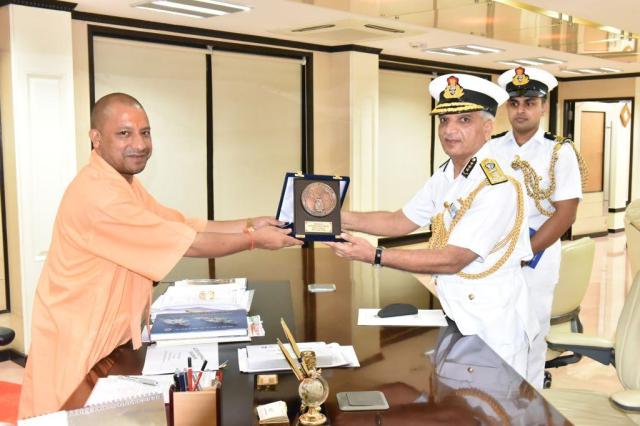
DGICG:Rajendra Singh called CM UP

thumbnail
DIRECTOR GENERAL INDIAN COAST GUARD RAJENDRA SINGH
CALLED ON HONORABLE CHIEF MINISTER OF UTTAR PRADESH SHRI YOGI
ADITYANATH ON MONDAY . HONORABLE CM WAS GIVEN A FIRST HAND
ACCOUNT OF COAST GUARD’S RESOLVE TO SECURE SEAMLESS SECURITY
ALL ALONG THE COASTLINE OF INDIA.
DIRECTOR GENERAL COAST GUARD ALSO SAID THAT THE
EXPANSION OF INDIAN COAST GUARD WITHIN THE STATE IS IN KEEPING
WITH THE COHESIVE DEFENCE MECHANISM OF THE ARMED FORCES
ACCORDING TO JOINT SECURITY REGIME.
HONORABLE CHIEF MINISTER ASSURED ALL OUT ASSISSTANCE IN
DEVELOPING INFRASTRUCTURE AND CAPACITY BUILDING OF THE INDIAN
COAST GUARD IN UTTAR PRADESH.