Thursday, 28 August 2014

 India ’s Foreign Trade and Investments.

28082014
India’s foreign trade has shown strong signs of recovery during the recent months. July exports growth in consistent with the previous month posted positive growth at 7.3%, however, trade deficit is registered at US$ (-) 12.2 billion as compared with US $ (-) 11.8 billion in June 2014. Trade deficit, though increased for the month of July but cumulative trade deficit from April – July 2014 is registered at US $ 45 billion which is relatively less as compared with US $ 60 billion registered during April-July 2013. The trade balance in services remained in surplus at  US $ 5.7 billion for the month of June 2014.

The FDI equity inflows in the month of June 2014 are estimated at around US$ 1.9 billion as against about US$ 3.6 billion in May 2013, posting a growth (Y-O-Y) of 34%. According to a global deal tracking firm Mergermarket, Mergers and acquisitions (M&As) in India witnessed a significant rise to US $17.1 billion, with a growth (Y-O-Y) of 47% in the first six months of the current year.

According to Economic Survey 2014-15 ‘External Sector’ of India reported positive developments. Agricultural exports from India rose by 5.1% in FY2014 and India ’s service sector is recognized as the second fastest growing services sector in the world with a CAGR of 9%. CAD in proportion to GDP declined from 4.7% of GDP to 1.7% of GDP.  India ’s foreign exchange reserves also posted a rise to US $304.2 billion at end March 2014.

External debt remains within manageable limits due to prudential external debt management policy. In contrast to these developments, Capital flows registered a sharp decline to US $ 47.9 billion in FY2014. Rupee was also depreciated significantly from Rs. 47.92 per US dollar in FY2012 to Rs. 60.50 per US dollar in FY 2013-14. While, overall BOP position recorded a significant improvement on account of measures taken by the Government and the RBI.

Budget 2014-15 announcement pertaining to India ’s External Sector are also positive and optimistic. Composite cap of FDI to be raised to 49% is announced to promote FDi in several sectors. SEZ will also be given special focus for their revival and strengthening. Basic Custom Duty of several items is reduced significantly inclusive of LED TV Panels, steel products etc.

With respect to WTO developments, WTO has raised questions over India ’s move to subside exports of sugar. While, WTO dispute panel report finds US CVD on India ’s steel products exports inconsistent with WTO law on subsidies. The most significant development at the global trade system was the holding of Trade Facilitation Pact by India , until a permanent solution on public stockholding for food security is found.

A historic signing by BRICS economies was done for establishing the New Development Bank (NDB) in Fortaleza , Brazil . The primary purpose of the bank is to mobilize resources for infrastructure and sustainable development projects in BRICS and other emerging and developing economies. The Bank shall have an initial authorized capital of US$ 100 billion.


Zee TV’ Neelee Chatriwala : Tune into your Inner Voice …

28082014
image013image014

Tune into your Inner VoiceZee TV’s light-hearted, slice-of-life drama explores
man’s journey of self-discovery through conversations with God

We have all wondered at one point or another what would happen if we meet God on earth? What if He has no miracles in store for you? What if He has more questions that make you introspect and listen to your own inner voice … How will your life change? These are just some of the questions faced by Bhagwan Das, the protagonist of Zee TV’s next weekend fiction show ‘Neeli Chhatri Wale Powered by Vinod Intelligent Cookware’ who has the privilege of meeting and befriending God.
Produced by Ashwini Dhir, the director of successful comedy films such as Son of Sardar & Atithi Tum Kab Jaaoge,Neeli Chhatri Wale follows the life of Bhagwan Das, the quintessential common man based out of Kanpur, constantly torn between his personal and professional life. Forever bullied either by his wife and father at home or his boss in the office, Bhagwan Das is always at the receiving end of flak. His kids are ashamed that he works as a salesman at ‘Titu Underwear and Baniyan’ and his wife constantly compares him to their neighbor who is better off in life. And then one day out of the blue, a handsome young man toting a blue umbrella emerges in front of him … a man only he can see … a man who embodies God! ‘Neeli Chhatri Wale’ is a light-hearted, slice-of-life drama highlighting Bhagwan Das and his relationship withShivaye – not as the hallowed, much revered divine avatar but as a smart, contemporary youth – conversing with whom puts Bhagwan Das in touch with his inner voice!

Noted for his critically acclaimed performances and serious roles across Hindi mainstream films, Yashpal Sharma will be seen playing Bhagwan Das in ‘Neeli Chhatri Wale’.  This will be a complete departure from his usual, dark brooding image and he will be seen as the much harried and hassled Bhagwan Das. Playing Shivaye is the strikingly handsome Himanshu Soni, noted for his impressive portrayal of the title role in Zee TV’s historical show ‘Buddha’. A friend philosopher and guide to Bhagwan Das, Himanshu will be seen essaying God like He’s never been presented before. Adding some spice and drama to Bhagwan Das’s life will be his nagging wife Bobby played by the famous Gujarati theatre actor Disha Savla, his Bauji played by veteran actorMithilesh Chaturvedi and his corrupt brother-in-law Govardhan Das played by Anoop Sharma.

Namit Sharma, Programming Head – Zee TV says, “After two successful fiction launches – Kumkum Bhagya and Jamai Raja this year, we now bring our viewers a weekend fiction property that delves into a subject so universal that it’s bound to appeal to viewers, cutting across all demographics. Neeli Chatri Waale is Zee TV’s initiative towards creating a differentiated weekend slot with original programming for the entire family. The show will be the first amongst several launches that will be a part of a special weekend ‘family unifier’ strategy.  Neeli Chhatri wale explores what happens when its protagonist meets and befriends God – it captures his journey of tuning into his own inner voice through conversations with God. Instead of giving him answers or delivering miraculous solutions, God throws questions at him, making him introspect and view life like he’s never seen before. We hope to take our viewers on a fascinating journey of self-discovery with this show!”

Producer Ashwini Dhir said, “The proposition of meeting God has always excited man. While most look at it as an opportunity for wish fulfillment, our show highlights how a relationship with God isn’t just about that … That God isn’t here to merely deliver miracles, but to question the way you think and get you to do some soul-searching. The conversations our protagonist has with this modern embodiment of God puts him in touch with his inner voice. We’ve got some interesting characters at the heart of our story … people that viewers can easily identify and relate with. Moreover, the tonality is light-hearted and entertaining.”

Neeli Chhatri Wale is being aggressively promoted by Zee TV using a media mix of print, radio and a comprehensive television plan, comprising a bouquet of channels spread across genres. A three phase digital campaign has been planned to engage with digital audiences. The first part of the digital campaign started with the introduction of #MyInnerVoice, sparking off conversations in the digital space about the moment when people felt most tuned into their inner voices. The entire promotional campaign for the show will aim at making God accessible to one and all by spreading the message of ‘Listen to your #InnerVoice.’

Starting 30th August, catch Bhagwan Das on a journey of listening to his inner voice through conversations with God every Saturday and Sunday at 8 PM, only on Zee TV.


PRESS INVITE AUGUST 28 12 NOON

28082014
PRESS INVITE AUGUST 28 12 NOON
From: shabnam hashmi <shabnamhashmi@gmail.com> Wed, 27 Aug ’14 7:03p
To: shabnam hashmi <shabnamhashmi@gmail.com>
Show full Headers
PRESS INVITE


August 27, 2014


Dear Sir/ Madam,

ANHAD is organizing a press conference tomorrow on August 28, 2014 at 12 noon at IWPC, 5, Windsor Place, New Delhi.

We are quite alarmed at the way the right wing is using ‘Love Jihad’ to polarize people and spread hatred between communities.

The term ‘Love Jihad’ is being used as a dangerous weapon. Messages on whatsApp and face book are flying and relating the phenomenon as an international conspiracy of the Muslims. Communal politics, communal violence all over uses women’s bodies as the site of contestation and community honour. Women’s sexuality is sought to be controlled as they are seen as the repository of culture, values, faith and honour.

Such campaigns against inter-religion, inter-caste marriages are not only against the spirit of a diverse and plural society they also aim to control women’s sexuality and polarise the society along communal lines for electoral and political purposes.

The speakers at the press conference will speak about different aspects of “RIGHT TO CHOOSE AND POLITICS OF ‘LOVE JEHAD”.

Speakers include: Vrinda Grover, Jagmati Sangwan (AIDWA), Annie Raja(NFIW), Manisha Bhalla( researcher) & Teesta Setalvad( social activist).

Kindly depute a reporter and a photographer to cover the press Conference.


Yours sincerely


Bhavna Sharma
8860125558


PGTI Feeder Tour, Faridabad: Dinesh Kumar sets the pace

28082014
Dinesh Kumar sets the pace in round one, makes two eagles in opening round of 71

Faridabad, August 27, 2014: Dinesh Kumar of Delhi shot a one-under-71 to take the round one lead in the PGTI Feeder Tour event being played at the Aravalli Golf Club in Faridabad, Haryana. Delhi’s Aditya Raj Kumar Chauhan, Karan Vasudeva, Ajay Baisoya and Gurgaon-based Deepinder Singh Kullar were one shot behind the leader in joint second place.

The highlight of Dinesh’s round were his two eagles on the third and 16th. Kumar landed it within a few inches for a tap-in eagle on the third and chipped-in for eagle on the 16th. He also had four birdies on his card including a conversion from 20 feet on the 18th. However, the 50-year-old seasoned pro, dropped seven strokes as a result of five bogeys and a double-bogey on the 14th.

“My driving and putting was top-class. I hit it well and made some long putts. The two eagles really boosted my morale. It’s a great start to the tournament. I just want to continue playing in the same manner,” said Dinesh.

Aditya Raj Kumar Chauhan, Deepinder Singh Kullar, karan Vasudeva and Ajay Baisoya shot matching scores of 72 to be tied second.

Local lad Ramesh Kumar was in joint sixth place at two-over-74 along with Noida’s Gaurav Pratap Singh and nine other golfers.

Wednesday, 27 August 2014

Peak Meat Production Strains Land and Water Resources:

27082014
Worldwatch Institute
To Me
Aug 26 at 8:11 PM
WW Color Logo_Green Blue
PRESS RELEASE
Tuesday, August 26, 2014
Contact: Gaelle Gourmelon,  ggourmelon@worldwatch.org

Peak Meat Production Strains Land and Water Resources

New Worldwatch Institute analysis examines global trends 
in meat production, prices, and practices
Washington, D.C.—-The steady growth of global meat production comes at considerable cost. Industrial methods in the livestock sector cut down forests to expand grazing lands and use large quantities of water. Production uses grains (such as corn or soybeans) for animal feed and relies on heavy doses of antibiotics in animals. Beef is particularly resource-intensive. Limiting these environmental and health impacts requires not only a look at how much meat people eat, but also at the kind of meat that they consume worldwide, writes Worldwatch Institute Senior Researcher Michael Renner.

Global meat production rose to a new peak of 308.5 million tons in 2013, according to the United Nations Food and Agriculture Organization (FAO). In response to growing purchasing power, urbanization, and changing diets, meat production has expanded more than fourfold over just the last five decades. Even more startlingly, meat production has grown 25-fold since 1800.

The growth in meat consumption has not been constrained by rising prices in the last decade. Worldwide, meat consumption stood at 42.9 kilograms (kg) per capita in 2013. Even though the gap is beginning to close, people in industrial countries continue to eat much larger quantities of meat (75.9 kg) than those in developing nations (33.7 kg).

Close to 70 percent of the planet’s agricultural land is used for animal pasture. Another 10 percent is used to grow grains to feed livestock (for meat and dairy). Producing beef is much more resource-intensive than producing pork or chicken, requiring roughly three to five times as much land to generate the same amount of protein. Beef production alone uses about three fifths of global farmland but yields less than 5 percent of the world’s protein.

Meat production also consumes a lot of water. Agriculture uses about 70 percent of the world’s available freshwater, and one third of that is used to grow the grain fed to livestock. Beef is by far the most water-intensive of all meats. The more than 15,000 liters of water used per kilogram is far more than is required by a number of staple foods, such as rice (3,400 liters per kg), eggs (3,300 liters), milk (1,000 liters), or potatoes (255 liters).

Worldwide, more than 40 percent of wheat, rye, oats, and corn production is fed to animals, along with 250 million tons of soybeans and other oilseeds. Feeding grain to livestock improves their fertility and growth, but it sets up a de facto competition for food between cattle and people.

Heavy doses of antibiotics are used to speed animal growth and reduce the likelihood of disease outbreak in cramped conditions. In the United States, 13,600 tons of antibiotics were sold for use in livestock operations in 2011-almost four times the 3,500 tons used to treat ill people. Even this number, however, pales in comparison with the possibly more than 100,000 tons used in China’s meat production.

Alternative practices could reduce these environmental and health impacts. Solutions like switching feed from grains to grass and other plants, using natural instead of synthetic fertilizers, and ending factory-style livestock operations are a start. But dietary choices also make a big difference. Until broader changes sweep through the meat-production system, eating less meat, or choosing lower-impact meats, typically means leading a less resource-intensive life.

Country and Regional Highlights from the Report:
  • Asia‘s 131.5 million tons of meat accounted for close to 43 percent of world output in 2013.  Europe was second (58.5 million tons), followed by North America (47.2 million tons) andSouth America (39.9 million tons).
  • China single-handedly accounted for nearly half of global pig meat production in 2013.
  • The two most important exporters of meat in 2013 were the United States (7.6 million tons) and Brazil (6.4 million tons), together representing 45 percent of global trade.
  • Just two countries-Australia and New Zealand-were responsible for a stunning 84 percent of the world’s lamb and mutton exports.
  • The 10 largest meat companies, measured by their 2011-13 sales, are headquartered in just six countries: Brazil (JBS, BRF, Marfrig), United States (Tyson Food, Cargill, Hormel Foods),Netherlands (Vion), Japan (Nippon Meat Packers), Denmark (Danish Crown AmbA), China(Smithfield Foods- acquired by Shuanghui International Holdings in 2013)

Monday, 25 August 2014

IAF All Women Cycling Expedition Team “Kshitij-Se-Pare” Flagged in Today

25082014
Air Marshal HB Rajaram, Air Officer-in-charge Administration, Air HQs today flagged in the ‘all women cycle expedition’ team on their successful completion of the mission ‘Kshitij-Se-Pare’.
The expedition consisting of nine women officers from the Indian Air Force team was led by Wing Commander Bhavna Mehra. This expedition started from Pathankot on 13 July 2014. The team covered a total distance of 1500 kms through one of the most treacherous terrain, at altitudes above 12000 ft with temperatures falling below freezing point and faced unpredictable weather conditions, reaching their destination Leh on 13 Aug 2014. This expedition has provided an opportunity for these women officers to nurture a spirit of adventure and camaraderie. The expedition took 32 days to complete. It was divided into three segments, were the first two segments were for acclimatisation and the third segment involved a high altitude cycling climb.
‘Kshitij-Se-Pare’ expedition has brought out the passion for adventure, will, strength and is a tribute to the very essence of indomitable Air Force spirit.


Indo Russian Air Force Exercise (Avia Indra-2014) Commences at Astrakhan

25082014
With the aim to bolster ties between the Indian Air Force and Russian Federation Air Force (RFAF), Ex Avia Indra-2014 commenced today at Astrakhan region, near the Caspian Sea in Russia. The Exercise which has begun today will go on till 05 September 2014.
Ex Avia Indra-2014 which has commenced today is the first exercise of its kind between the two Air Forces and is seen as a major mile stone in military relations. This involves participation of fighter pilots, helicopter pilots, missile combat crew, as well as engineers from the Indian Air Force (IAF) along with their counterparts of the RFAF. During the exercise, fighter and helicopter pilots of Indian Air Force (IAF) will participate in missions alongside Russian pilots in aircraft of the Russian Federation Air Force (Su-30SM fighter aircraft, Mi-17 and Mi-35 helicopters), while missile combat crew will interact with their counterparts from the Russian Air Force and participate in Air Defence exercises. It will also provide an opportunity to both the forces for exchange of best practices and will cement the foundation for a more professional interaction and growth in the future.


Protest outside Harsh Vardhan’s residence to demand his resignation

25082014
From: AAP Media Cell <aapmediacell11@gmail.com> Mon, 25 Aug ’14 5:54p
To: undisclosed-recipients:;
Show full Headers
8 attachments – Download all
1.jpg344.87 KBDownload
4.jpg267.18 KBDownload
5.jpg318.93 KBDownload
6.jpg346.00 KBDownload
7.jpg339.80 KBDownload
8.jpg421.35 KBDownload
9.jpg431.88 KBDownload
10.jpg413.43 KBDownload
                                       Monday, August 25
Please find enclosed the photographs of the protest by the residents and volunteers of the Aam Aadmi Party’s Krishnanagar Vidhan Sabha assembly segment, outside union health minister Dr Harsh Vardhan’s residence.
The protest was organised against the health minister’s direct compromise with corruption by shunting out whistleblower officer, Mr Sanjeev Chaturvedi from the post of Chief Vigilance Officer of AIIMS.
The protestors displayed placards and posters demanding the health minister';s resignation for victimising an honest officer at the behest of BJP leaders, who were angry with Chaturvedi for exposing corruption at AIIMS.
The health minister is changing his stand everyday and is making false statements in a desperate bid to wriggle out of his unjustified and untenable decision to compromise with corruption by having shunted out a honest officer on the instructions of BJP leadership.
The health minister had tweeted on Friday (August 22) that Chaturvedi had been twice rejected by the CVC and that his continuation as CVO of AIIMS was “irregular and indefensible”.   
The minister on Saturday changed his stand from rejection to opposition by the CVC in 2012 and 2013. The AAP dares the health minister to put in public domain any document which has support his claim.
The fact is that the CVC did not either reject or oppose Chaturvedi’s appointment as the CVO of AIIMS, a clarification sought by the commission is being twisted and wrongly presented by the health minister to mislead the country in a desperate bid to divert attention since his direct compromise with corruption now stands fully exposed.
Regards.


City all set for the third edition of Hriday Manch,

25082014
City all set for the third edition of Hriday Manch, a four-day annual theatre festival by Sparsh Natya Rang starting 28th August’14

New Delhi, August 25, 2014: A treat to theatre loversis up next as SparshNatya Rang, a Delhi based theatre group formed in the year 2005 that has been associated with a number of eminent actors, directors, writers etc.is all set to present its third annual theatre festival – “HridayManch” at Sri Ram Centre, Mandi House at 7pm from 28th to 31stAugust’14 that will have have showcasing of plays by different groups. Not only has itprovided a platform for theatre in Delhi but has also for different theatre groups, folk dancers and musicians in various states. Since inception, Sparsh has also been associated with special initiatives for underprivileged children.
HridayManch is a step ahead, providing a unique platform for theatre groups in and outside Delhi to come forward and stage plays as also for theatre enthusiasts who get to view them.
This will have four plays, one performed on each day- Neem Hakeem Khatra-E-Jaan, Sakharam Binder, Bobby Breaker and AadhiSadi. Each promising to entertain its audience thoroughly with generous doses of comedy, drama and romance, it won’t be unwise to make time to watch these.

Setting the motion would be the play Neem Hakeem Khatra-e- Jaanwritten by Moliereon Day 1 which is Sparsh Natya Rang’s own production. The play that has its adaptation by V K Sharma, Amitabh Srivastava and music and direction by Ajit Chowdhury will surely leave you in splits with its comic plot about a wife seeking revenge on her drunkard husband as he’s forced from being a woodcutter to an accidental doctor.
Sakharam Binder, written by Vijay Tendulkar will be staged on Day 2. It will be presented by Himachal Culture Research forum Theatre Repertory and directed by Suresh Sharma. Be ready for some high intensity drama as the book binder- Sakharam openly contests the hypocrisy of the marriage system and denounces societal rules while drawing up his own.

30th August will witness Bobby Breaker, a play about  the young Bobby who struggles with his stammering problem while the society mocking calls him “ Bobby Breaker”. But, Bobby is resolved to overcome all, come what may for the love of his life, Ms. Choudhary.

Fourth and the last day will have the play “AadhiSadi” staged by SambhavArt group that is written by Chandradhar Sharma Guleri, Jainendra Kumar, Yashpal and BishmSahni and directed by Devendra raj Ankur. This production is an enactment of four short stories – Ussne Kaha Tha , Pazeb, Parda and Chief kiDawat, set in different time zones and locales. They depict the first 50 years of modern Hindi literature and all are bound by the common thread – LOVE.
“Hriday Manch” is definitely your chance at taking that theatre leap!


Scientists discover how Tibetan people can live at high altitudes:

25082014
                                                                                  August 25, 2014
•Researchers say Tibetans have a genetic variation that enables them to survive in high
altitude, low oxygen environments
• This could explain how they can survive at heights of 14,800 feet (4,510m)
• The mutation is believed to have originated 8,000 years ago
• It gives them a selective advantage in their environment over other humans
• Finding could lead to novel solutions for diseases such as cancer
• Tibet is a high-altitude plateau region north-east of the Himalayas in China
Sure, Wolverine’s claws were impressive, but how would one of the most famous X-Men have coped if he’d tried to survive at a height of over 14,000ft (4,270 metres)?
The answer would most likely be ‘not well’, but while off-limits to some, it turns out that people such as Tibetans can thrive in the thin air of high-altitude areas thanks to an 8,000 year-old mutation.
Researchers say they’ve successfully identified this genetic variation for the first time, and it could explain how some people can survive in these extreme environments.
Researchers say Tibetans (pictured) have a genetic variation that enables them to survive in high altitude, low oxygen environments. This could explain how they can survive at heights of 14,800 feet (4,510m)
The research from the University of Utah appears in the journal Nature Genetics and looked at areas such as the Tibetan Plateau.
‘These findings help us understand the unique aspects of Tibetan adaptation to high altitudes, and to better understand human evolution,’ said Dr Josef Prchal, senior author and University of Utah professor of internal medicine.
In 2010 Prchal’s group was the first to establish that there was a genetic basis to Tibetan high altitude adaptation.
Since then, together with Dr Felipe Lorenzo, the team have proved that the DNA of Tibetans has a slight variation that prevents their body struggling with a lack of oxygen.
Instead, 88 per cent of Tibetans have the mutation that enables their bodies to thrive in low-oxygen environments, something that is virtually absent from closely related lowland Asians.
It is believed the change began 8,000 years ago, when the gene EGLN1 changed by a single DNA base pair.
The findings indicate the tiny genetic change endows its carriers with a selective advantage.
HOW THE RESEARCHERS OVERCAME THE RECLUSIVE NATURE OF TIBETANS
For his research, Dr Prchal needed Tibetans to donate blood, from which he could extract their DNA, a task that turned out to be more difficult than he ever imagined.
It took several trips to Asia, meeting with Chinese officials and representatives of exiled Tibetans in India, to get the necessary permissions to recruit subjects for the study.
But he quickly learned that official documents would not be enough.
Wary of foreigners, the Tibetans refused to participate.
To earn the Tibetans’ trust, Dr Prchal obtained a letter of support from the Tibetan spiritual leader, the Dalai Lama.
‘The Dalai Lama felt that a better understanding of the adaptation would be helpful not only to the Tibetan community but also to humanity at large,’ said Dr Prchal.
He also enlisted the help of native Dr Tibetan Tsewang Tashi, an author and clinical fellow at the Huntsman Cancer Institute at the University of Utah.
More than 90 Tibetans, both from the US and abroad, ultimately volunteered for the study.
When traveling with Dr Tashi in Asia, Dr Prchal was surprised at how he got Tibetans to grasp the research they were being asked to take part in.
Dr Tashi simply helped them realise that their ability to adapt to life at high altitude was unique.
‘They usually responded by a little initial surprise quickly followed by agreement,’ said Dr Tashi.
‘It was as if I made them realise something new, which only then became obvious.’
The mutation, believed to have originated 8,000 years ago, gives Tibetans a selective advantage in their environment over other humans. The finding could lead to novel solutions for diseases such as cancer. Tibet is a high-altitude plateau region north-east of the Himalayas in China (shown)
For his research, Dr Prchal (shown) needed Tibetans to donate blood, from which he could extract their DNA, a task that turned out to be more difficult than he ever imagined. It took several trips to Asia, meeting with Chinese officials and representatives of exiled Tibetans in India, to get the necessary
Dr Prchal collaborated with experts throughout the world, including co-senior author Dr Peppi Koivunen from Biocenter Oulu in Finland, to determine that the newly identified genetic variation protects Tibetans by decreasing an aversive over-response to low oxygen.
In those without the adaptation, the thin air causes their blood to become thick with oxygen-carrying red blood cells, often causing long-term complications such as heart failure.
The EGLN1 variation however, together with other unidentified genetic changes, collectively supports life at high altitudes.
Dr Prchal says the research also has broader implications.
Because oxygen plays a central role in human physiology and disease, a deep understanding of how high altitude adaptations work may lead to novel treatments for various conditions, including cancer.
‘There is much more that needs to be done, and this is just the beginning,’ he said.
Scientists discover how Tibetan people can live at high altitudes: 8,000 year-old genetic mutation enables them to survive with less oxygen   By Jonathan O’Callaghan for MailOnline |

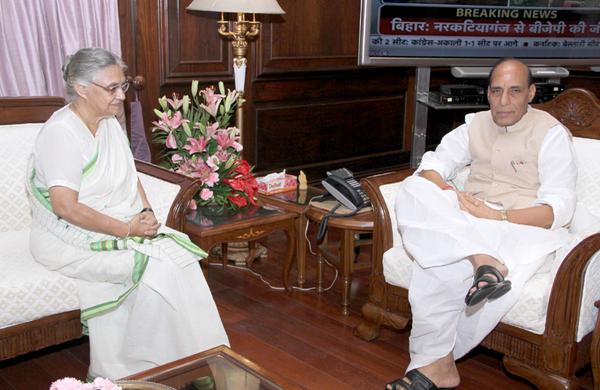
शीला दीक्षित, केंद्रीय गृह मंत्री श्री राजनाथ सिंह से मुलाकात करते हुए

Standard
केरल की राज्यपाल, श्रीमती शीला दीक्षित, केंद्रीय गृह मंत्री श्री राजनाथ सिंह से मुलाकात करते हुए। 
Embedded image permalink
About these ads
Occasionally, some of your visitors may see an advertisement here.